

![shutterstock_2718825413 [Converted].png](https://static.wixstatic.com/media/8eb170_b02269cb5fa04633b70b270cbefe5a5f~mv2.png/v1/fill/w_980,h_891,al_c,q_90,usm_0.66_1.00_0.01,enc_avif,quality_auto/shutterstock_2718825413%20%5BConverted%5D.png)
The Oklahoma Graduation Effect
Overview: The Oklahoma Center for Public Affairs (OCPA) conducted a study on the influence of high school graduation on social and economic conditions in our state. The current high school graduation rate for Oklahoma public schools is 80%. The national average is 87%, and at least 15 states have a high school graduation rate of 90% or higher.[1]As reported below, OCPA’s study revealed that raising graduation rate from 80% to 90% could have a ripple effect that would significantly and positively impact the social and economic fabric of Oklahoma.
Foundational Literature on Graduation Effect
High school graduation rates have proven to be a useful metric for analyzing socio-economic impact (Belfield, et. al, 2023). Every school system in the U.S. is responsible for reporting graduation rates, and this data is publicly available online through the National Center for Education Statistics (NCES) website at https://nces.ed.gov/. There are two federally mandated measures of high school graduation that are collected by local school districts and reported to state departments of education who then submit them annually to the U.S. Department of Education (DOE). The two measures are the Adjusted Cohort Graduation Rate (ACGR) and the Average Freshman Graduation Rate (AFGR).[1]
Studies indicate that improving graduation rates significantly improves state trajectories in health, revenue, crime, and civic engagement (NCES, 2020; Blackwell et al., 2014; Lochner and Moretti, 2004). Students who do not graduate from high school face a greater likelihood of health and financial risks, including lower life expectancy, limited employment prospects, lower lifetime wages, and increased risk of incarceration (APHA, 2018; Hoagwood, et al., 2023).
OCPA Study
In 2025-26, the Oklahoma Center for Public Affairs (OCPA) examined how increasing Oklahoma’s high school graduation rate from 80 percent to 90 percent could influence economic and social conditions over time. Based on a freshman cohort of approximately 54,000 students, a ten-percentage-point increase would result in about 5,400 additional graduates in a given year.
For purposes of estimation, the analysis for this study assumes that these additional graduates would participate in the workforce at rates similar to current high school graduates and would earn comparable wages. The analysis also assumes that available employment opportunities exist to absorb these workers, allowing their earnings to remain within Oklahoma’s economy rather than leaving the state through unfilled positions or labor shortages. Under these conditions, the additional income earned by the new graduates would increase economic activity within the state and serve as the basis for the projected impacts described below.
Increasing high school graduation rates influences the economy through two primary channels. First, high school graduates participate in the workforce at higher rates than non-graduates. As a result, some individuals who otherwise would not have been employed are assumed to enter employment and earn wages comparable to current high school graduates. Second, among those who would have been employed regardless of graduation status, completing high school is associated with higher average earnings.
Based on the influence of these two channels, the analysis estimates that approximately 67 new graduates who otherwise would not be employed due to lack of education would enter the workforce. Furthermore, more than 3,000 workers would experience increased earnings due to higher educational attainment. The combined effect produces an estimated annual income increase of approximately $54 million for the affected cohorts, which is calculated by using observed wage differences between graduates and non-graduates. Because higher earnings increase consumer spending, the additional income is also assumed to support a modest number of additional jobs through secondary demand effects, bringing total employment gains to roughly 100 jobs.
The direct increase in income for the new high school graduates will generate additional economic activity through a multiplier effect. As noted above, the assumption is that the new graduates’ greater skills and employability prevent outsourcing to other states and/or attract business activity from outside the state. New graduates would spend a portion of their income, generating increased income for others, who spend a portion of that income, and so on until the impact plays out.
In economic analysis, a multiplier is the amount of change that occurs when an initial external force, such as new graduates’ income and spending, ripples throughout the economy, creating an increasingly larger effect. Multipliers frequently hover around the 2–3 range because this magnitude reflects a balance between initial investment and subsequent economic ripples. In this study, a conservative multiplier of 2.7 is applied, bringing the total income/GDP impact to an increase of $145 million. Since investment is about 21 percent of GDP, it increases by about $30 million. This economic impact would be fully felt several years after the increase in the graduation rate and if higher graduation rates are maintained for a generation, the outcome would amount to several times these amounts.
Other economic effects are calculated based on recent percentages of GDP. New car sales would increase by 2.6 percent of the added GDP, or by $3.8 million. Using a similar calculation, state and local government revenue would increase by $13 million. Home sales, discounted for Oklahoma’s relatively low median home price, would increase by $56 million (obviously, down-payments would be a much lower number). And finally, private spending would increase by $97 million.
Implications
OCPA’s study supports the prior research reported in this article, which posits that increasing the number of high school graduates can generate cascading benefits for both the graduates and the state in which they reside. Oklahoma high school graduates face greater job prospects, higher incomes, better health, and are less likely to live in poverty. In addition, the new graduates’ increased income and quality of life generate additional economic activity and social benefits throughout the state.
Increasing the number of high school diplomas depends heavily on what happens before graduation. Oklahoma must ensure that students leave high school with necessary knowledge, skills, and dispositions to be successful. Everyone has a role in this endeavor.
School systems must provide innovative instructional approaches that provide students with a rigorous and relevant curriculum aligned with college-ready standards and career-related experiences. Parents set the stage for a lifetime of success and are the biggest influence in a child’s learning. Policymakers shape the overall conditions in which education occurs and make important decisions on educational funding.
When Oklahoma invests in education, it invests in social and economic growth because education shapes the quality of its workforce, its level of innovation, and the overall well‑being of its population. Education is the foundation of Oklahoma’s economic future, just as roads and bridges are the foundation of its physical infrastructure. Collective efforts of educators, parents, policymakers, business and nonprofit leaders, and other advocates, can pave the way to increase our graduation rates, which can lead to a better Oklahoma.
Summary of Findings from OSCPA Study

The current high school graduation rate for all students in Oklahoma is 80%. Increasing the graduation rate to 90%, within a short time, could mean…
-
5,400 individuals yearly with enhanced salaries
-
$54 mil added income for new graduates
-
$145 to $160 mil added GDP
-
$35.1 mil in earnings
-
26.6 mil in spending
-
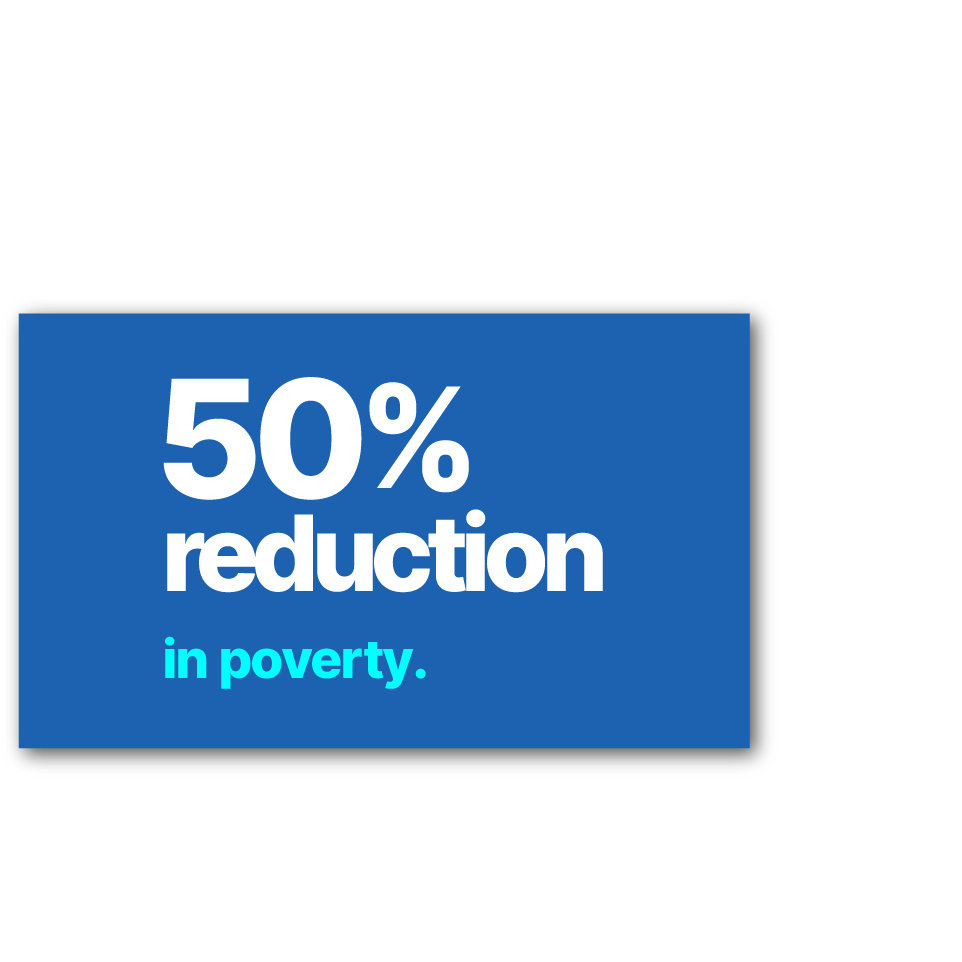
50% reduction in poverty
-
6.5% reduction in crime rates
-
$13 mil in state & local tax revenue
-
$56 mil in home sales
-
$30 mil added investment
-
$97 mil private spending
-
$3.8 mil new car sales
-
$5.4 mil in federal tax revenue
-
$51.2 mil savings on health care
-
$38 mil savings on crime and incarceration
Summary of Findings from Literature

A substantial body of literature suggests that increasing graduation rates can lead to:
-
Higher Earnings and Spending: Graduates typically earn more than non-graduates. This means they have more disposable income to spend on goods and services, which boosts local businesses and generates more sales tax revenue (NCES, 2024).
-
Increased Tax Contributions: With higher earnings, graduates contribute more income taxes, which can be used to fund public services and infrastructure (All4Ed, 2025; Belfield, et. al, 2023)




REFERENCES
[1] These states include Montana, Maine, Vermont, New Hampshire, Wyoming, Minnesota, North Dakota, Alaska, Wisconsin, Utah, Iowa, South Dakota, Hawaii, Colorado, and Connecticut, all with reported rates above 91%.
[1] NCES posts a very useful blog by Joel McFarland (2017) that explains the difference between the ACGR and the AFGR. https://nces.ed.gov/learn/blog/what-difference-between-acgr-and-afgr
-
Attract Business and Industry: A more educated workforce can attract businesses needing skilled labor, potentially leading to more jobs and economic growth in the state (Berger and Fisher, 2013).
-
Reduced Public Assistance Costs: Higher education levels generally lead to lower unemployment rates, reducing the need for unemployment benefits and other public assistance programs and decreased state expenditures in these areas (Baker, 2018).
-
Improved Individual and Public Health: Education often correlates with better health outcomes, reducing state spending on healthcare services (Freudenberg and Ruglis, 2007; Qu, et. al., 2016; Zajacova and Lawrence, 2018).
-
Improved Quality of Life: Education attainment correlates with improved physical and mental health, longer life expectancy, and better quality of life (Freudenberg and Ruglis, 2007; Qu, et. al., 2016; Zajacova and Lawrence, 2018).
-
Reduced Poverty: Higher educational attainment is strongly correlated with poverty reduction (Johnson and Tanner, 2018).
-
Reduced Crime and Incarceration: Education is strongly correlated with lower crime, leading to reduced costs for incarceration and the criminal justice system (Lochner and Moretti, 2004).
-
Increased Life Expectancy: Research suggests a relationship between high school graduation and longevity (Sylte, 2025, Zajacova and Lawrence, 2018).
All4Ed. (2025). Increasing national high school graduation rate key to job creation and economic growth, new alliance analysis finds. https://all4ed.org/press_release/increasing-national-high-school-graduation-rate-key-to-job-creation-and-economic-growth-new-alliance-analysis-finds/
American Public Health Association. (2011). The dropout crisis: A public health problem and the role of school-based health care. Center for School, Health and Education.
Baker, B. D. (2018). How money matters for schools. Learning Policy Institute. https://learningpolicyinstitute.org/product/how-money-matters-report
Belfield, C., Levin, H. M., & Rosen, R. (2014). The economic benefits of equity across California schools. California MTSS Research Consortium. https://transformschools.ucla.edu/wp-content/uploads/2023/06/CAMTSS_ResearchConsortiumBriefs_Economic-Benefits-of-Equity.pdf
Berger, N., & Fisher, P. (2013). A well-educated workforce is key to state prosperity. Economic Policy Institute. https://www.epi.org/publication/states-education-productivity-growth-foundations/
Blackwell, D. L., Lucas, J. W., & Clarke, T. C. (2014). Summary health statistics for U.S. adults: National Health Interview Survey, 2012 (Vital and Health Statistics, Series 10, No. 260). National Center for Health Statistics. https://www.cdc.gov/nchs/data/series/sr_10/sr10_260.pdf
Freudenberg, N., & Ruglis, J. (2007). Reframing school dropout as a public health
issue. Preventing Chronic Disease, 4(4), A107.
Guide to Community Preventive Services. (2013). Social determinants of health: High school completion programs. The Community Guide. https://www.thecommunityguide.org/findings/social-determinants-health-high-school-completion-programs.html
Hoagwood, K. E., Walker, D. K., Edwards, A., Kaminski, J. W., Kelleher, K. J., Spandorfer, J., & Fox, E. G. (2023). Vital signs for pediatric health: High school graduation. NAM Perspectives. https://nam.edu/perspectives/vital-signs-for-pediatric-health-school-readiness/
Johnson, R. C., & Tanner, S. (2018). Money and freedom: The impact of California’s school
finance reform (research brief). Palo Alto, CA: Learning Policy Institute.
Lochner, L., & Moretti, E. (2004). The effect of education on crime: Evidence from prison inmates, arrests, and self-reports. American Economic Review, 94(1), 155–189. https://doi.org/10.1257/000282804322970751
National Center for Education Statistics. (2020). Public high school 4-year adjusted cohort graduation rate (ACGR), by race/ethnicity and selected demographic characteristics: School year 2018–19. U.S. Department of Education. https://nces.ed.gov/ccd/tables/ACGR_RE_and_characteristics_2018-19.asp
National Center for Education Statistics. (2024). Annual earnings by educational attainment. Condition of Education. U.S. Department of Education, Institute of Education Sciences.
Qu, S., Chattopadhyay, S. K., Hahn, R. A., & Community Preventive Services Task Force.
(2016). High school completion programs: A community guide systematic economic review. Journal of Public Health Management and Practice, 22(3), E47–E56. https://doi.org/10.1097/PHH.0000000000000286
Scherer, Z., & King, M. D. (2025). How education impacted income and earnings from 2004 [Blog post]. U.S. Census Bureau. https://www.census.gov/library/stories/2025/09/education-and-income.html
Sylte, D. O., Baumann, M. M., Kelly, Y. O., et al. (2025). Life expectancy by county and educational attainment in the USA, 2000–19: An observational analysis. The Lancet Public Health. https://doi.org/10.1016/S2468-2667(24)00303-7
Zajacova, A., & Lawrence, E. M. (2018). The relationship between education and health: Reducing disparities through a contextual approach. Annual Review of Public Health, 39, 273–289. https://doi.org/10.1146/annurev-publhealth-031816-044628